

How it works
- Choose your source — local files, a ZIP archive, OneDrive, or Google Drive
- Pick a match strategy — match filenames to UID (default), name, or any roster field
- Select photos — browse and select the images you want to import
- Review matches — CaptrID shows you which photos matched, which need attention, and which didn’t match anyone
- Upload — confirmed matches are uploaded and appear in the session’s approval queue
Where to find it
There are two entry points for bulk upload:Setting up a bulk upload
Step 1: Choose a source
Select where your photos are coming from:- Local Files — select multiple images from your computer, or upload a ZIP archive
- OneDrive — sign in with your Microsoft account and browse folders
- Google Drive — use the Google Picker to select files
OneDrive and Google Drive import require a Pro plan or higher. On the Starter plan, you’ll see an upgrade prompt. Local file upload is available on all plans.
Step 2: Choose a match strategy
Tell CaptrID how to match filenames to people:
Filenames are compared without the file extension. So
STU001.jpg, STU001.png, and STU001.jpeg all match the same way.
Step 3: Select photos
How you select photos depends on your source: Local files:- Click Select Files to pick individual images, or Upload ZIP to upload an archive
- Supported formats: JPEG, PNG
- ZIP archives are extracted automatically — nested folders are flattened
- A sign-in popup opens — sign in with any Microsoft account
- Browse your folders using the grid view with thumbnails
- Select individual files or entire folders
- The Google Picker opens — search or browse your Drive
- Select the files you want to import

Source selection showing Local Files, OneDrive, and Google Drive options
Step 4: Review matches
After selecting photos, CaptrID analyses filenames and shows results across three tabs: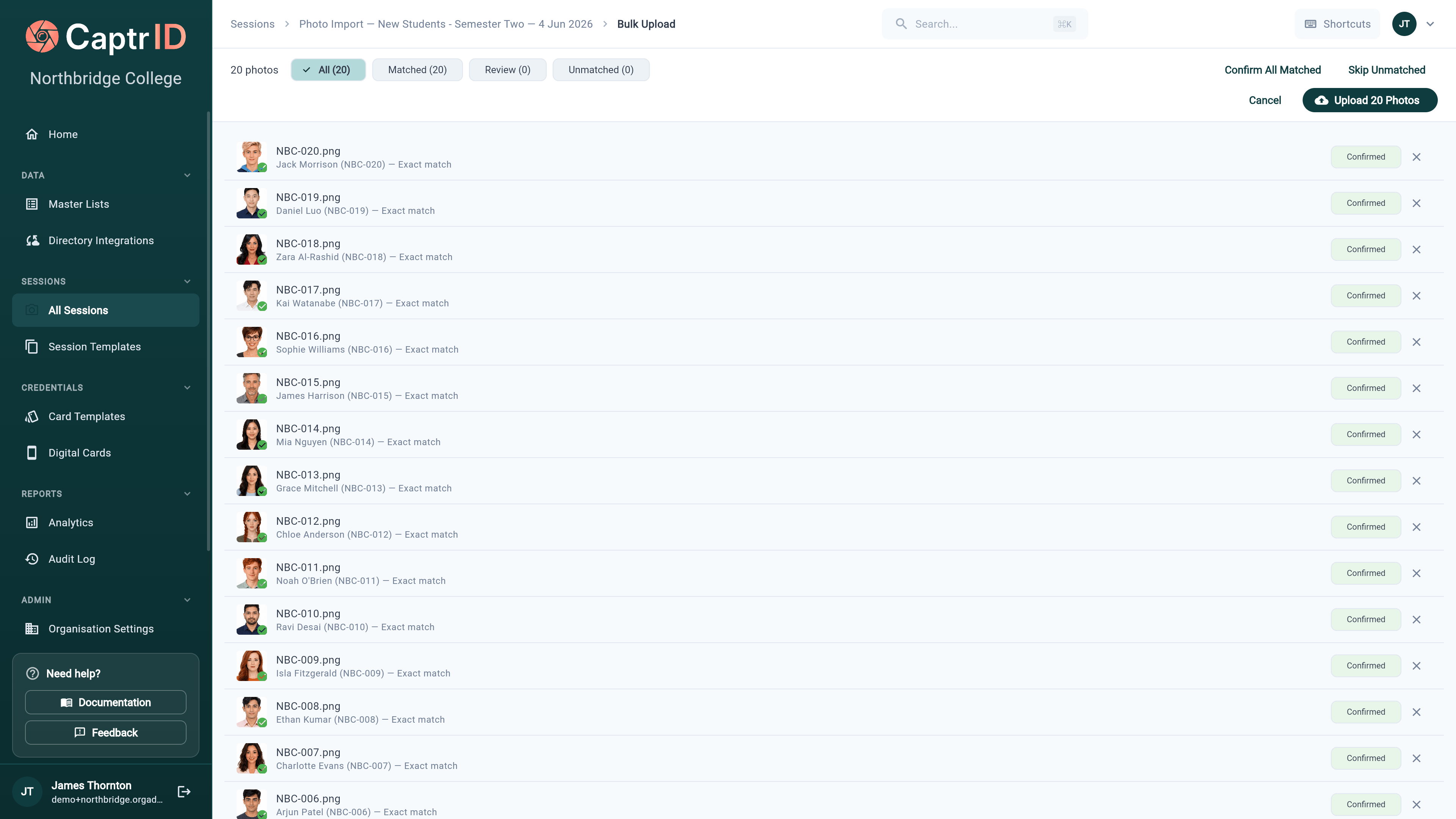
Review screen with matched, needs review, and unmatched tabs showing photo previews and match status
- Click Assign next to the unmatched photo
- Search for the person by name, UID, or any field
- Select the correct person
- The photo moves to the Matched tab
Step 5: Upload
Once you’re happy with the matches:- Optionally enable Auto-approve — this approves all uploaded photos immediately (useful when importing from a trusted source like a professional photographer)
- Click Upload
- A progress bar shows per-file upload status
- When complete, you’ll see a summary of successful uploads, skipped files, and any errors
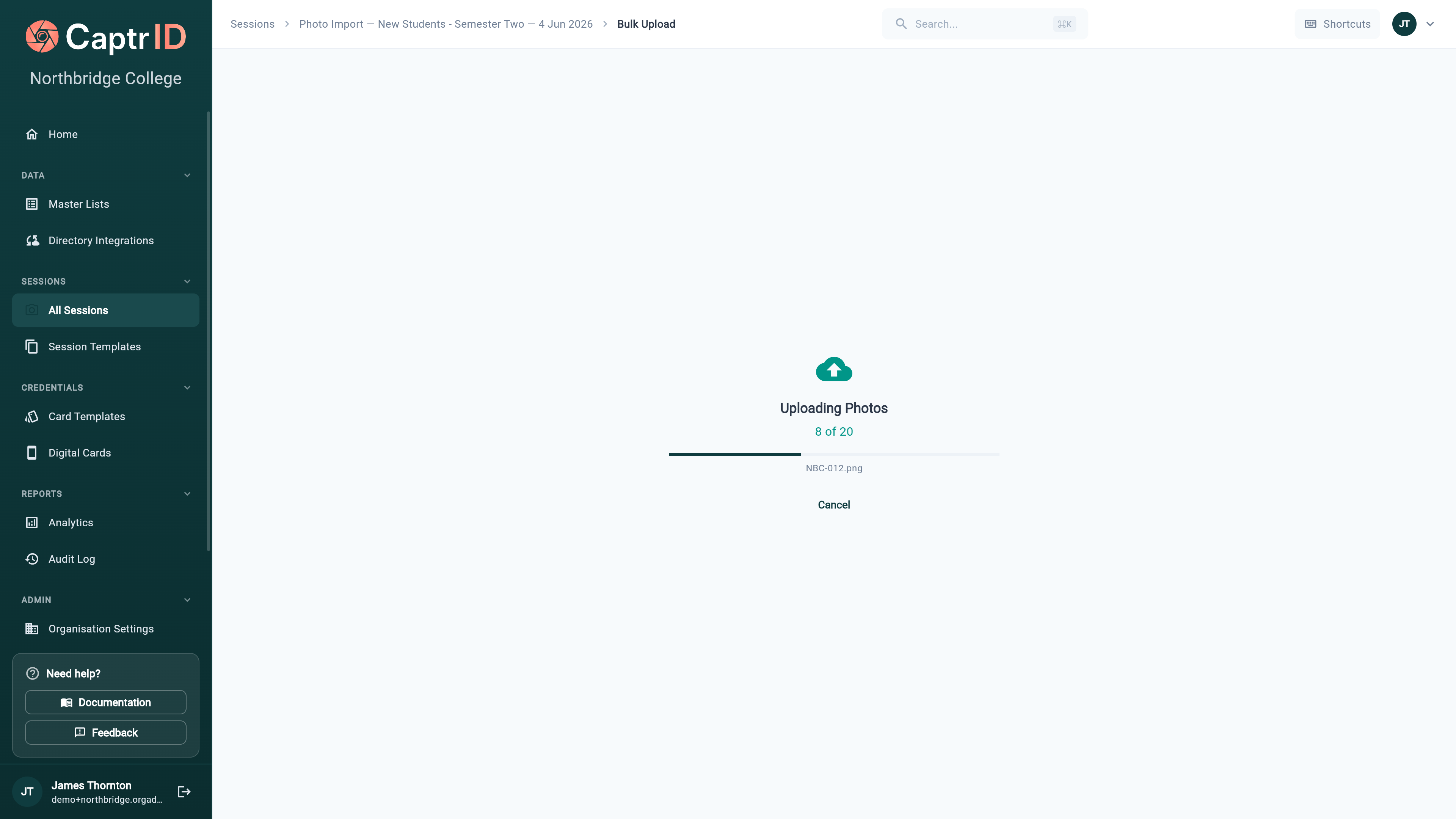
Upload progress showing individual file status and overall completion percentage
Using a CSV manifest
If your ZIP archive contains amanifest.csv file, CaptrID uses it to map filenames to roster members instead of relying on filename matching. This is useful when filenames don’t match any roster field (e.g. camera-generated names like IMG_4821.jpg).
The CSV should have at least two columns:
Example manifest.csv:
Importing photos to a master list
The Import Photos button on the master list detail screen runs the entire pipeline in one step:- Creates a temporary photo session linked to the master list
- Walks you through the bulk upload flow (source, matching, review)
- Uploads matched photos as submissions
- Auto-approves all submissions
- Generates and applies a ChangeSet to sync photos back to the master list
- Photographer deliveries — import a folder of images after a photo day
- Annual photo refresh — replace outdated photos in bulk
- Migration from another system — bring your existing photo library into CaptrID
The temporary session and ChangeSet are created automatically. You don’t need to manage them — but they’re visible in your session list and audit logs for traceability.
Plan limits
Tips
- Use consistent filenames — the simplest approach is naming files with the person’s UID (e.g.
STU001.jpg). If your photographer can do this, matching is automatic. - Use a manifest for camera files — if filenames are camera-generated (
IMG_xxxx.jpg), include amanifest.csvin your ZIP to map them. - Review before uploading — take a moment to check the Needs Review tab. Fuzzy matches are often correct, but it’s worth confirming.
- Enable auto-approve for trusted sources — if the photos come from a professional photographer, auto-approve saves time. You can always reject individual photos later.
- Import to master list for one-click setup — the “Import Photos” flow on the master list handles everything. Use it when you just want to get photos attached to people quickly.
- Check your plan — OneDrive and Google Drive import require Pro or higher. Local file upload works on all plans.