

Airtable sync requires a Pro or Business plan. Pro plans support 1 sync provider; Business plans support multiple connections.
How it differs from Entra
Step 1: Connect your Airtable account
- Go to Directory Integrations in the sidebar
- Click Add Connection
- Choose Airtable as the provider
- You’ll be redirected to Airtable to authorise access. CaptrID requests these scopes:
- Approve the request and you’ll return to CaptrID with the connection listed as Connected
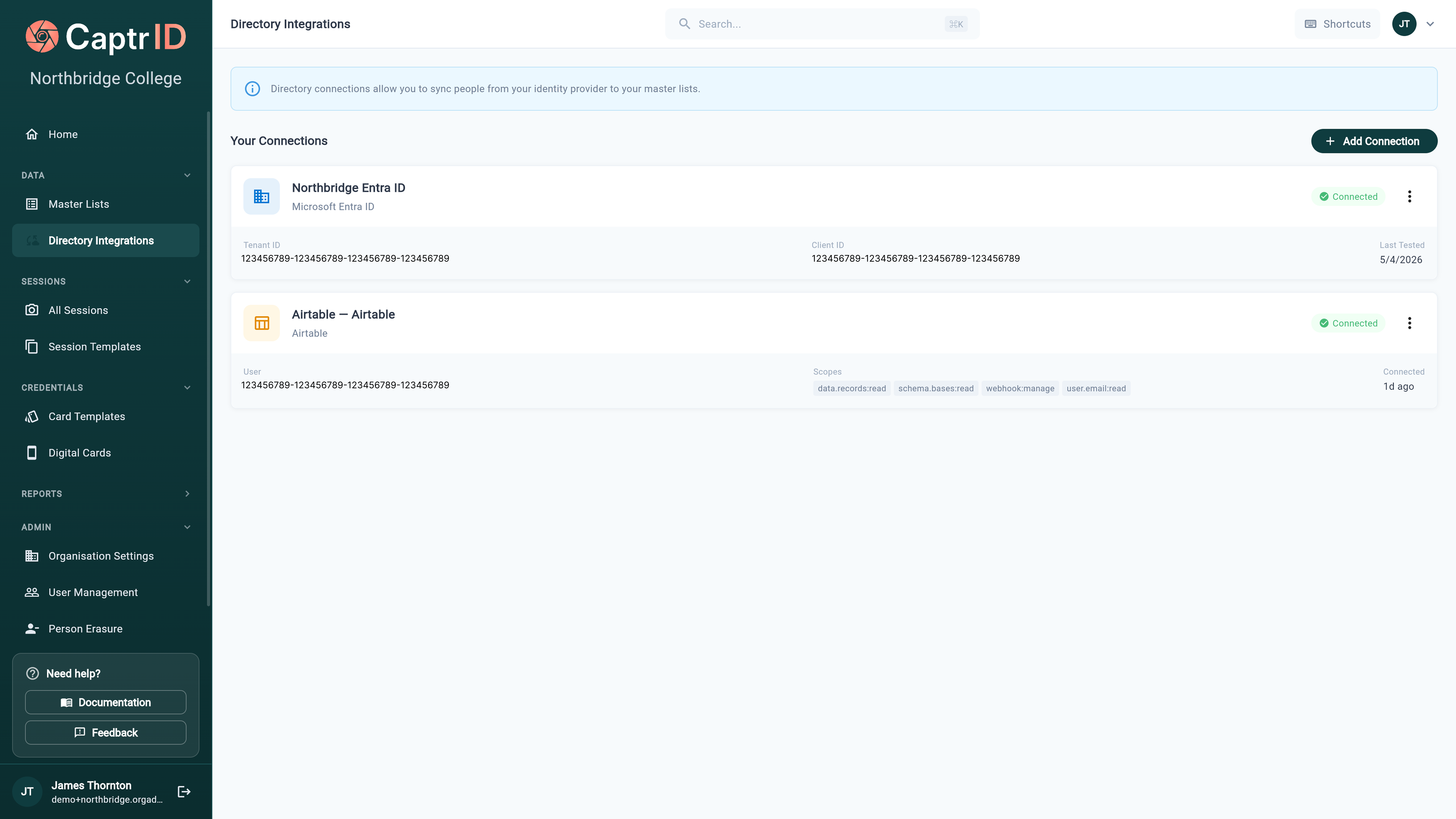
The Directory Integrations screen showing an Airtable connection with its granted scopes alongside a Microsoft Entra ID connection
An Airtable connection is shared across your organisation and acts on behalf of the user who authorised it. Anyone with permission to manage Master Lists can use the connection to configure a sync — they don’t each need their own Airtable login.
Step 2: Configure sync on a Master List
You can connect a sync when creating a new Master List or on an existing one:- During list creation — choose Airtable as your source and pick your connection
- On an existing list — open the list, go to the Sync tab, and click Configure Sync
Step 3: Pick a base and table
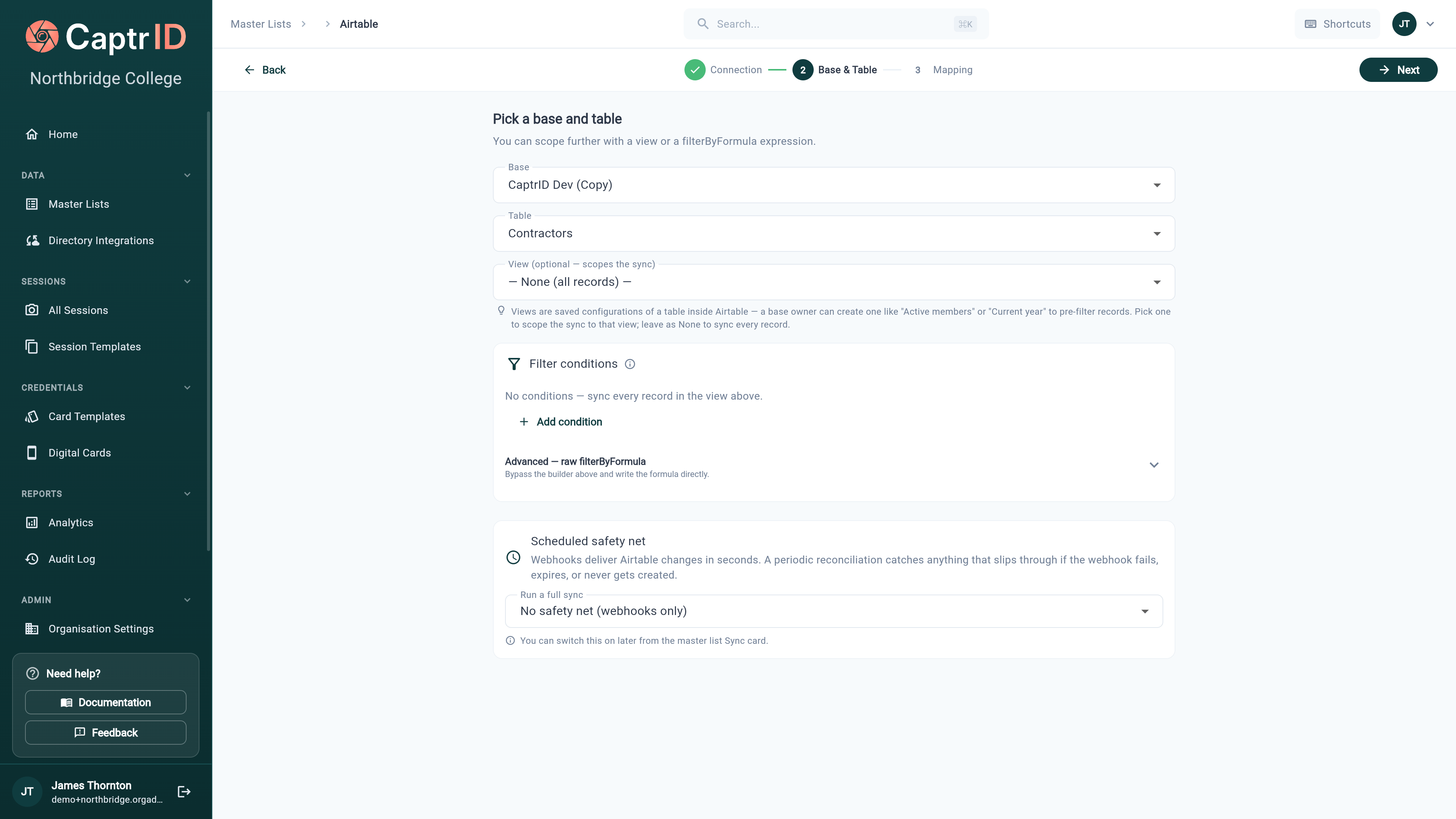
The Airtable wizard's Base & Table step — choosing a base, table, optional view, and filter conditions
- Select the Base you want to sync from
- Select the Table within that base
- (Optional) Choose a View to scope the sync. Views are saved configurations inside Airtable — a base owner can create one like “Active members” or “Current year” to pre-filter records. Leave it as None to sync every record.
Filter conditions
Narrow down which records sync without touching Airtable:- Add condition — build filters in CaptrID (e.g. Status is Active)
- Advanced — raw
filterByFormula— bypass the builder and write an Airtable formula directly
Scheduled safety net
Webhooks deliver Airtable changes in seconds, but a periodic full sync catches anything that slips through if a webhook fails, expires, or never gets created.Step 4: Map your fields
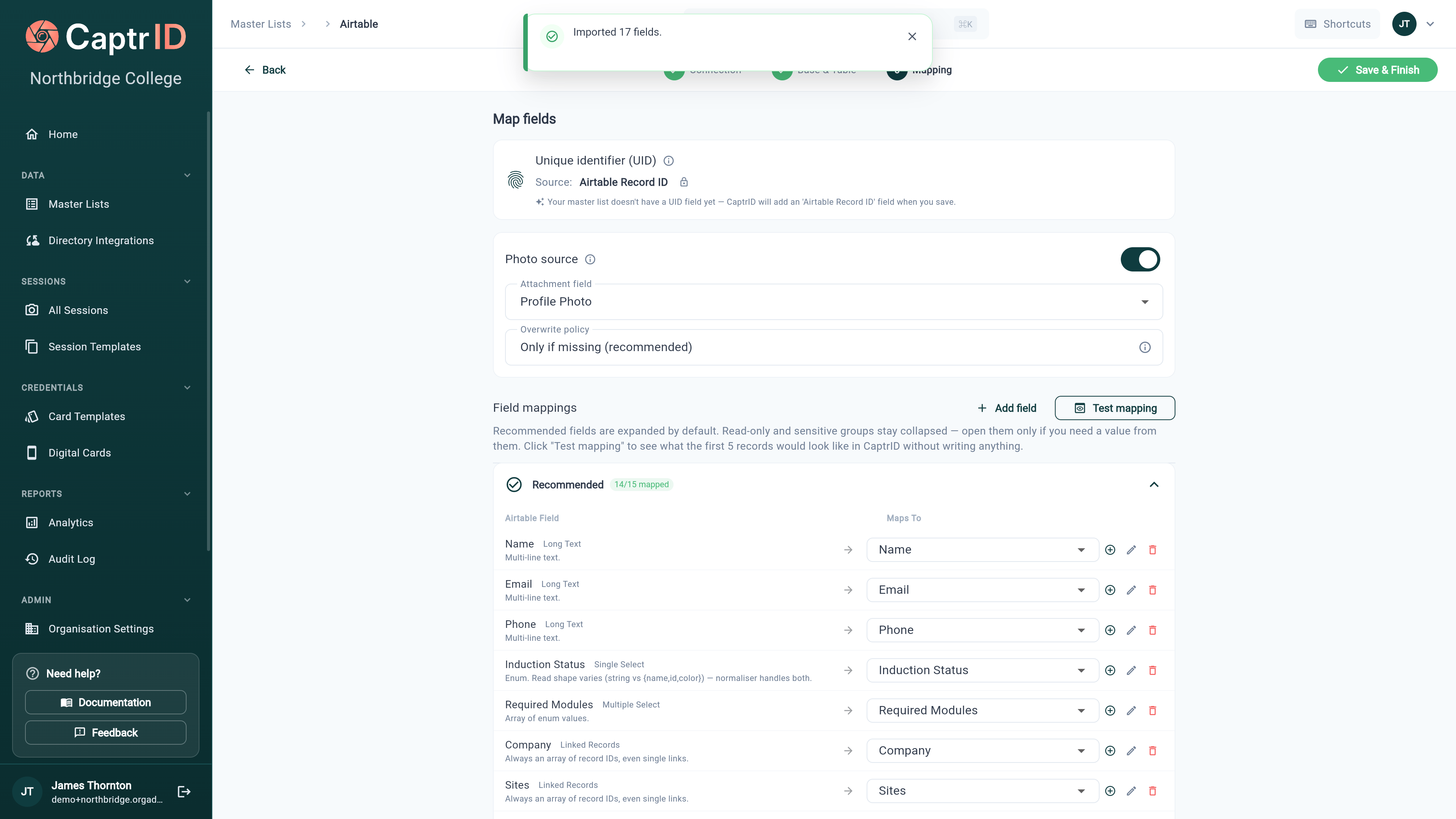
The Airtable field mapping step — UID source, photo attachment field, overwrite policy, and categorised field mappings
Unique identifier (UID)
Airtable’s own Record ID is the most stable identifier, so CaptrID uses it by default. If your Master List doesn’t have a UID field yet, CaptrID adds an “Airtable Record ID” field automatically when you save.Photo source
Toggle Photo source on to pull headshots from an Airtable Attachment field:- Choose the Attachment Field that holds the photo (e.g. “Profile Photo”)
- Choose an Overwrite policy:
Field mappings
CaptrID reads your table’s schema and suggests mappings automatically. Fields are grouped, with Recommended fields expanded and read-only or sensitive groups collapsed.- Auto-mapped fields show a green tick (e.g. Name → Name, Email → Email)
- Add field — create a new Master List field on the fly for an unmapped Airtable field
- Test mapping — preview what the first five records will look like in CaptrID without writing anything
Step 5: Run the first sync
After saving:- Go to the Sync tab on your Master List
- Click Sync Now to run the first backfill
- Review the results — people created, updated, photos imported, and any errors
The Sync card
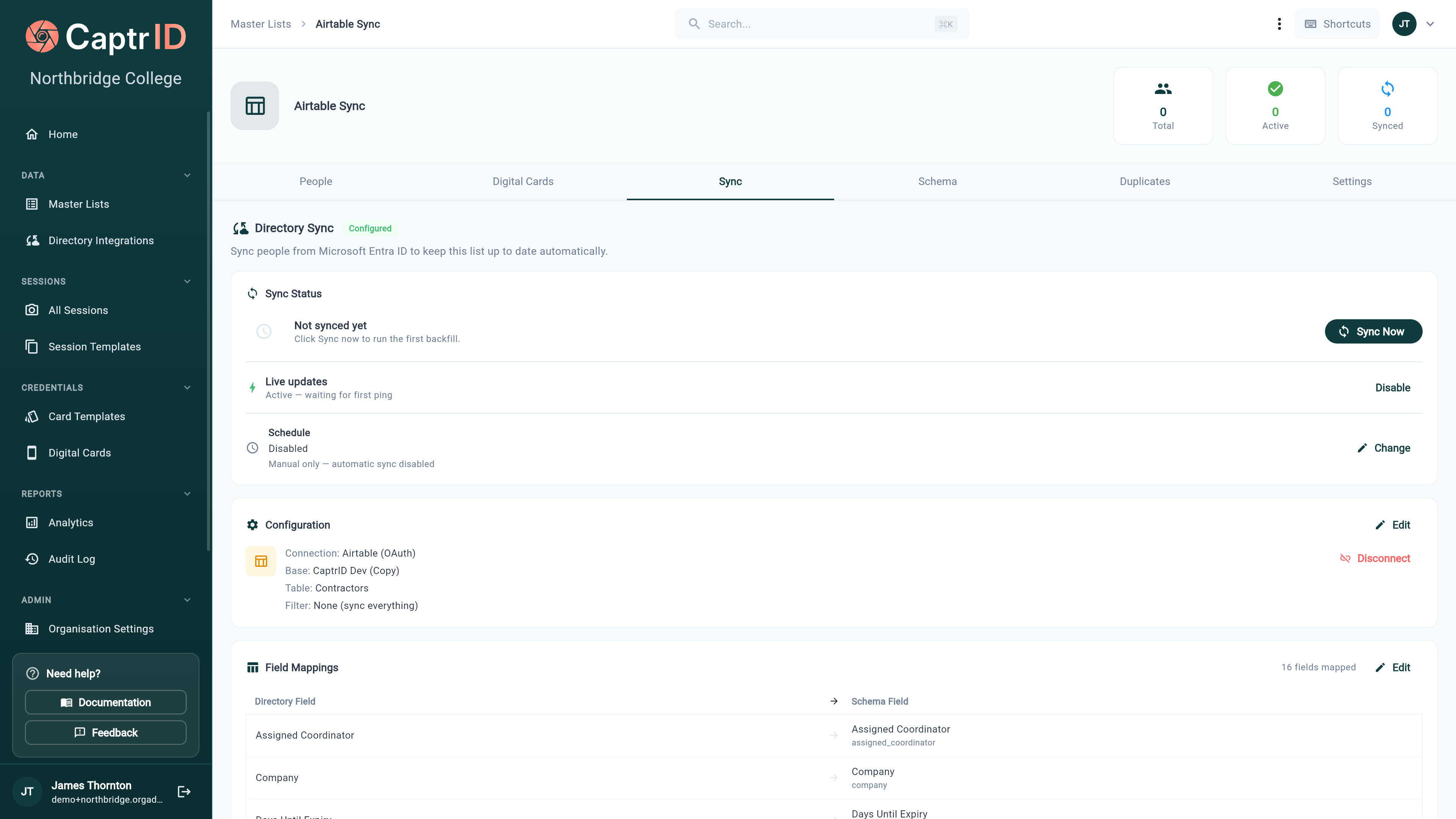
The Master List Sync tab showing sync status, live updates, schedule, configuration, and field mappings
Live updates (real-time sync)
When live updates are active, CaptrID registers a webhook with Airtable using a notify-and-poll pattern: Airtable pings CaptrID when something changes, and CaptrID then fetches the changed records. Edits — including replaced photos — appear in your Master List within seconds.Airtable allows a limited number of webhooks per base. If you hit the limit, disable live updates on a connection you no longer need, or rely on the scheduled safety net instead.
Editing synced people
People synced from Airtable have their mapped fields locked in the Master List, so a manual edit isn’t overwritten on the next sync. You can still:- Edit fields that aren’t mapped to Airtable
- Use synced people in sessions (edits happen on the session copy, not the master)
- Push approved photos back from sessions via Save to Master List
Disconnecting
To stop syncing a Master List from Airtable:- Open the Master List → Sync tab
- Click Disconnect in the Configuration section
- Confirm
- The webhook is removed and sync stops
- All existing people remain in the Master List
- Previously locked fields become editable
- You can reconnect and re-enable syncing later
Troubleshooting
What’s next?
Directory Sync (Entra ID)
Sync from Microsoft Entra ID instead — same Directory Integrations screen.
Saving changes back
Push approved photos and field edits from a session back to your Master List.